
Key Takeaways
- The "Lost Decade" Myth: While the S&P 500 dominated from 2009-2024, 2025 proves that market leadership is cyclical. International stocks have surged, reminding investors that no single asset class wins forever.
- The 2025 Reversal: A weaker U.S. dollar and global fiscal stimulus have flipped the script, with international developed and emerging markets significantly outperforming U.S. large caps this year.
- Diversification's True Role: A diversified portfolio isn't designed to beat the hottest index every year; it's engineered to capture growth wherever it occurs and protect wealth from catastrophic single-market risks.
- The Currency Tailwind: For U.S. investors, holding foreign assets provides a hedge against a declining dollar, a benefit that added substantial returns to portfolios in 2025.
- Discipline Over Chasing: The hardest part of investing isn't picking stocks but sticking to a strategy when it feels uncomfortable. Diversification requires the discipline to hold underperforming assets today so they can be tomorrow's leaders.
For the better part of the last decade, the most common question from high-earning investors has been some variation of: "Why don't we just put everything in the S&P 500?"
It's a fair question. Since the end of the Global Financial Crisis, U.S. large-cap stocks have been a juggernaut, delivering returns that have often left other asset classes in the dust. As a financial advisor, I've found myself in the somewhat paradoxical position of advocating for strategies, namely diversification into international stocks, small caps, bonds, etc., that year after year, seemed to drag down portfolio performance compared to a simple S&P 500 index fund.
The truth is, a diversified portfolio is always "apologizing" for something. One part of your portfolio will almost always be underperforming the top-performing asset class of the moment. That's not a bug; it's a feature.
And as 2025 has demonstrated, the tables can turn, and they can turn quickly. For the first time since 2017, the narrative has flipped, with international stocks not just beating, but doubling the return of the S&P 500. This year serves as a critical reminder of why diversification remains the cornerstone of long-term wealth preservation and growth.
The Era of U.S. Dominance (2009-2024)
To understand the current landscape, we have to appreciate the extraordinary run of U.S. stocks. From the market bottom in March 2009 through the end of 2024, the S&P 500 delivered a phenomenal annualized total return of over 14%.
In stark contrast, international developed markets (measured by the MSCI EAFE Index) returned an annualized ~8% (using ticker EFA), and emerging markets (MSCI Emerging Markets Index) were closer to ~6% over the same period (using ticker EEM).
During this era, a U.S.-centric portfolio was the clear winner. This performance was driven by several factors:
- The rise of dominant U.S. tech giants (the FAANGs and their successors).
- A generally strong U.S. dollar, which reduces the returns of foreign investments for U.S.-based investors.
- A U.S. economy that was often seen as the "cleanest shirt in the laundry basket" compared to slower-growing European and Asian economies.
It's no wonder investors grew comfortable with a heavy home-country bias.
2025: The Year the Narrative Flipped
Then came 2025. In a dramatic reversal, the long-held trend broke. As of December 8th 2025, the performance landscape looks radically different:
- International Developed Stocks (MSCI EAFE): +~32%
- Emerging Markets (MSCI EM): +~35%
- U.S. Large Cap (S&P 500): +~15.7%
For the first time in nearly a decade, a diversified portfolio with significant international exposure is outperforming a U.S.-only portfolio, and by a substantial margin. What changed?
While many complex factors are at play, a few key drivers stand out:
- The U.S. Dollar's Decline: After years of strength, the U.S. dollar has weakened significantly against major foreign currencies in 2025. For U.S. investors, this provides a powerful tailwind. When you own foreign assets, a falling dollar means your investments are worth more when converted back into USD. This currency effect alone is responsible for a significant portion of the international outperformance.
- Global Fiscal Stimulus & Policy Shifts: Facing a more complex geopolitical environment marked by increased tariffs and "icier" international relationships, many foreign governments and central banks have responded with aggressive fiscal stimulus and supportive monetary policies to boost their domestic economies. This has fueled growth and corporate profits in regions that had previously lagged.
- Valuation Mean Reversion: At the start of 2025, U.S. stocks were trading at historically high valuations, while international markets were comparatively cheap. The recent performance reflects a natural "mean reversion," where capital flows away from expensive assets toward those offering better value and earnings potential.
The Apology is the Strategy
The lesson of 2025 isn't that international stocks are now the "best" investment and U.S. stocks are "bad." It's that markets are cyclical. Leadership changes. Yesterday's laggard is often tomorrow's leader, and vice-versa. Here is a chart of the different asset classes that lead in performance over since 2010:
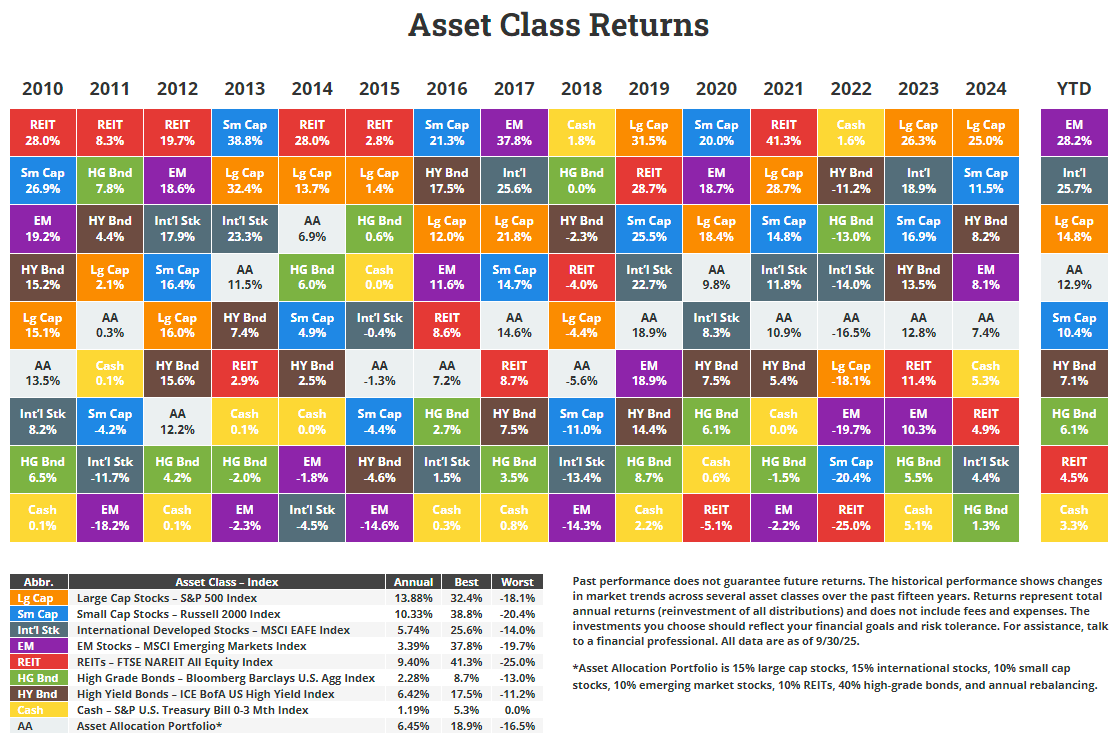 Source: NovelInvestor.com
Diversification is commonly referred to as the only investment "free lunch" because it acknowledges that we cannot predict the future. When you are broadly diversified, you:
- Avoid Catastrophic Risk: You aren't entirely dependent on the performance of a single country, sector, or currency. If the U.S. market enters a prolonged bear market, your entire portfolio won't suffer the full brunt.
- Capture Returns Wherever They Appear: You don't have to guess which region or asset class will outperform next. You already have exposure to it. In 2025, diversified investors are capturing the significant gains in Europe and Asia that a U.S.-only investor would have missed entirely.
- Smoother Ride: By combining asset classes that don't move in perfect lockstep, you can potentially reduce the overall volatility of your portfolio. This makes it easier to stick to your long-term plan during inevitable periods of market turbulence.
Yes, a diversified portfolio means you will always have some assets that are underperforming the day's "hot" investment. It will always be "apologizing" for something. But as 2025 reminds us, that "apology" is the price you pay for the invaluable benefit of a resilient, all-weather portfolio designed to build and protect wealth across changing market cycles.
The goal isn't to beat the S&P 500 every single year. The goal is to achieve your financial objectives with a level of risk you can tolerate. And for that, diversification is not something to apologize for, it's something to celebrate but it can be hard to keep your focus on the bigger picture when there is so much FOMO.
Why You Need a Strategic Partner
Navigating these shifts isn't easy. The emotional pull to chase recent winners or abandon underperformers is strong, and it can derail even the most disciplined investor. This is where a partnership with a trusted financial partner becomes invaluable.
At Purpose Built we don't just build portfolios; we construct resilient financial plans designed to weather changing market cycles. Our expertise allows us to:
- Objectively Rebalance: We take the emotion out of selling high (recent winners) and buying low (undervalued assets), ensuring your portfolio stays aligned with your long-term goals.
- Identify Global Opportunities: We actively monitor international markets, valuations, and economic trends to ensure your portfolio is positioned to capture growth wherever it occurs, not just in the U.S.
- Provide Behavioral Coaching: We help you stay the course when the market is volatile or when a specific asset class is dominating the headlines, preventing costly knee-jerk reactions.
At Purpose Built, we understand that true wealth management is about more than just investment selection; it's about integrating your portfolio with your tax strategy, retirement goals, and personal values. We are here to help you design a portfolio that you can stick with for the long haul, giving you the confidence to ignore the noise and focus on what matters most.
Don't let market shifts catch you off guard. Contact Purpose Built today to review your portfolio and ensure your investment strategy is truly diversified and built for lasting success.
About the Author
Sean Lovison, CPA, CFP®, is a fee-only financial planner and founder of Purpose Built Financial Services. After spending 14 years as a corporate chief financial officer (CFO), receiving and designing compensation plans, he decided to help others navigate their plans.
Purpose Built Financial Services is a state registered (PA and NJ) advisor but legally able to virtually serve high-earning households in all 50 states. While we specialize in the unique tax complexities of the NJ/NY/PA tri-state corridor, our 'Personal CFO' model is designed for tech leaders nationwide who require sophisticated equity and tax coordination.
All written content on this site is for information purposes only. Opinions expressed herein are solely those of Sean Lovison and Purpose Built Financial Services (PBFS), unless otherwise specifically cited. The material presented is believed to be from reliable sources, and no representations are made by our firm regarding other parties' informational accuracy or completeness. All information or ideas provided should be discussed in detail with an advisor, accountant, or legal counsel prior to implementation.
The information on this site is provided "AS IS" and without warranties of any kind, either express or implied. To the fullest extent permissible pursuant to applicable laws, PBFS disclaims all warranties, express or implied, including, but not limited to, implied warranties of merchantability, non-infringement, and suitability for a particular purpose. PBFS does not warrant that the information will be free from error. None of the information provided on this website is intended as investment, tax, accounting, or legal advice, as an offer or solicitation of an offer to buy or sell, or as an endorsement of any company, security, fund, or other securities or non-securities offering. The information should not be relied upon for purposes of transacting securities or other investments. Your use of the information is at your sole risk. Under no circumstances shall PB be liable for any direct, indirect, special, or consequential damages that result from the use of, or the inability to use, the materials on this site, even if PB or a PB-authorized representative has been advised of the possibility of such damages. In no event shall Purpose Built have any liability to you for damages, losses, and causes of action for accessing this site. Information on this website should not be considered a solicitation to buy, an offer to sell, or a recommendation of any security in any jurisdiction where such offer, solicitation, or recommendation would be unlawful or unauthorized.
.jpg)


